
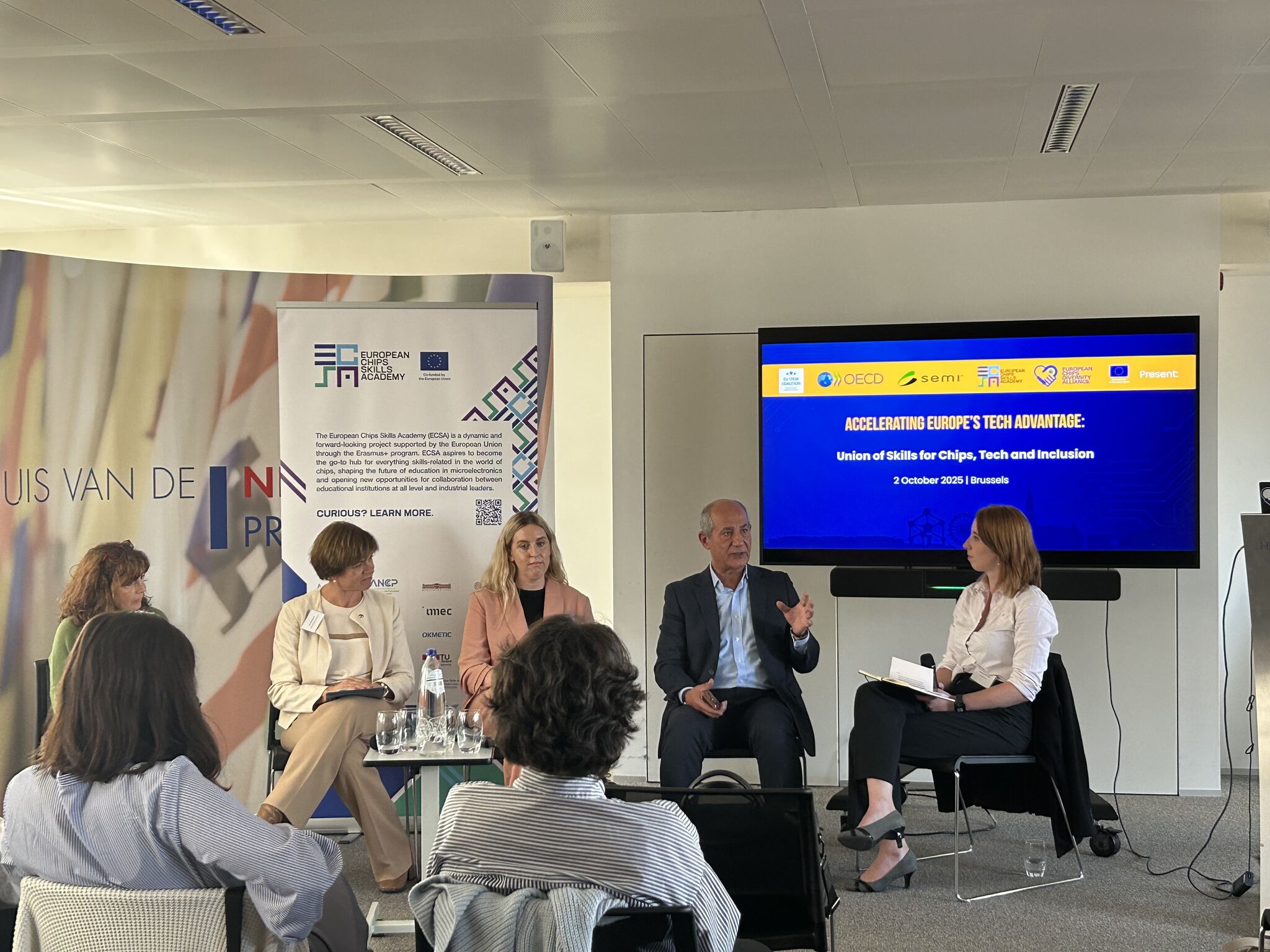
The European Chips Diversity Alliance co-organised the event Accelerating Europe’s Tech Advantage: Union of Skills for Chips, Tech and Inclusion in Brussels on October 2nd, bringing together key stakeholders from across policy, industry, and education to address Europe’s growing semiconductor talent challenge.
Held in the context of the European Commission’s Union of Skills initiative, the event highlighted the urgent need to strengthen STEM education and align talent development with the evolving demands of high-tech sectors, including semiconductors. With projections indicating a shortage of over 75,000 roles in the semiconductor industry by 2030, discussions focused on how Europe can build a resilient and future-ready workforce.
Organised in collaboration with OECD, SEMI Europe, the EU STEM Coalition, and theEuropean Chips Skills Academy, the event featured keynote contributions and expert insights from leading voices across Europe. Topics ranged from the current state of STEM education to the impact of the talent gap on industrial competitiveness and innovation.
Laith Altimime, President of SEMI Europe, underlined the scale of the semiconductor talent challenge and the need for coordinated action across education and industry. Andreas Schleicher, Director for Education and Skills at OECD, provided a broader perspective on global education trends, while Beatrice Boots, representing the EU STEM Coalition, highlighted ongoing European-level efforts to strengthen STEM ecosystems.
A central panel discussion brought together Laith Altimime and Nessa Maguire (EudaOrg), alongside other leading voices, to explore the effectiveness of current STEM promotion initiatives – particularly in relation to the participation of women and underrepresented groups in high-tech fields. Moderated by Victoria Cummings from SEMI Europe, the discussion examined whether existing approaches are delivering measurable impact and how messaging, workplace culture, and education systems can better support inclusive participation in the semiconductor sector.
The discussion also addressed broader questions around Europe’s ability to remain competitive in key technological areas such as artificial intelligence, cybersecurity, and advanced manufacturing, all of which depend on a strong and diverse talent pipeline.
As co-organiser, ECDA played a key role in shaping the dialogue, reinforcing the importance of inclusive approaches to workforce development and the need to bridge gaps between education, policy, and industry.
The event concluded with a networking reception, providing an opportunity for participants to exchange ideas and strengthen collaboration across sectors.
This engagement marks another step in ECDA’s ongoing efforts to support a more inclusive, skilled, and future-ready semiconductor ecosystem across Europe.

 Co-funded by